


 Apple Podcasts
 Spotify
 iHeartRadio
 Amazon Music
 The Garage
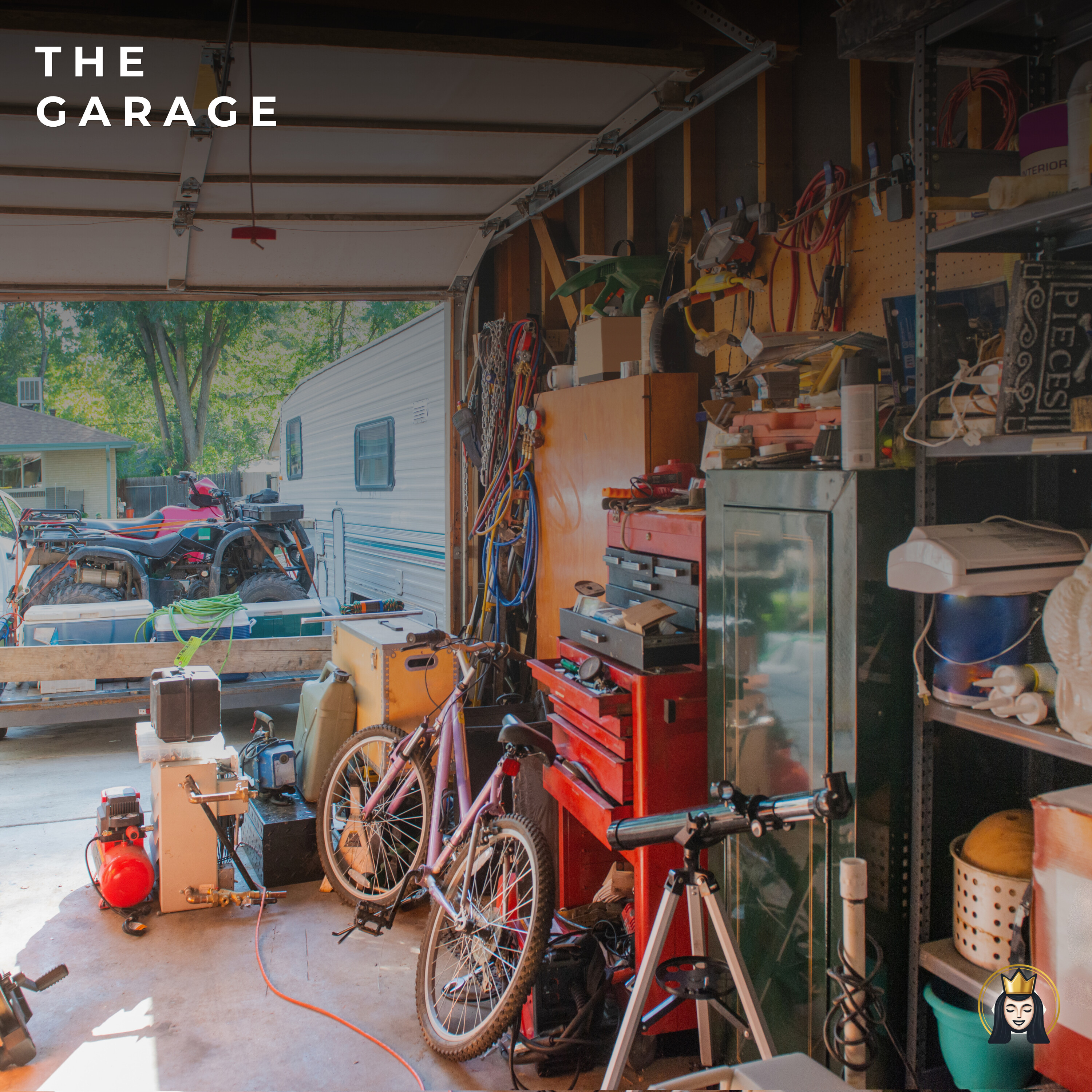
I turn my focus to one of the most intimidating spaces in many homes: the garage. I talk about how garages stop being a home for our cars and instead become black holes for forgotten projects, expired paint cans, broken tools, dusty holiday decorations, old furniture, and boxes labeled “miscellaneous.” Because the garage is out of our main sightlines, it often becomes “storage for indecision” – the place we toss things when we don’t want to decide whether to keep them or let them go. Over time, the whole family uses it as a dumping ground, and the result is total overwhelm. But I emphasize that a cluttered garage is not a permanent problem; with the right system and mindset, it’s absolutely fixable.
I walk listeners through five practical steps to declutter the garage:
first, set the scope by choosing just one zone to work on instead of tackling the entire garage. Second, group by category so you can see everything clearly and spot duplicates. Third, make clear decisions item by item by asking whether you use it, whether it still works, and whether you’d buy it again. Fourth, toss, donate, or rehome using a simple rule of three and responsible disposal for things like paint and chemicals. Finally, store smart with clear labeled bins, vertical storage, wall hooks, shelves, and pegboards, while keeping the floor as clear as possible.
From there, I shift into mindset and maintenance: setting a monthly reminder to tidy, making sure everyone in the household knows what goes where, and refusing to use the garage as a “decide later” zone. I offer a challenge to listeners to pick just one corner of their garage this week, sort it, let go of what they don’t use, and notice the momentum that follows.
In the second half, I’m joined by my cousin Debbie Myers, who asks how to get motivated to declutter. I share five motivation-boosting strategies: shrinking the task until it feels easy, attaching decluttering to daily triggers, using a simple trash/donate/keep system, decluttering with a “body double” like a podcast or a friend, and stopping before exhaustion so the process feels doable and even satisfying.
Mary Anne Ivison 0:01
The Declutter Queen with Avery Cundill.
Avery Cundill 0:05
I'm Avery Cundill, and this week we're moving to an interesting place. You guessed it, the
Matt Cundill 0:12
garage.
Avery Cundill 0:16
Let's be honest, most garages are not home for our cars anymore. They're black holes of forgotten projects, expired paint cans, broken tools, dusty holiday decoration, and boxes labeled miscellaneous. They are sometimes full of furniture that got handed down to us from a family member, and maybe just maybe they are dumping grounds for appliances and kitchen spillover. I could go on and on, but I think you get my gist. We shove so much stuff into our garages to get these items out of our way and out of our sight, but then the trickle-down effect is that our garages get so cluttered it's hard to find the doorway out. If just thinking about your garage makes you want to shut the door and walk away, you're not alone. You may be even thinking of turning this episode off, because well, I don't want to deal with my garage ever. It's the room nobody ever wants to deal with. I am here to tell you to stay with me, and don't worry, we're not going to declutter it all in one weekend. I'm pretty sure that it took more than a day to end up with this garage mess, so give yourself some time. So today, what I'd like to do is talk about a realistic step-by-step plan to break down the chaos and finally reclaim your garage,
Matt Cundill 2:02
we why do garages get so out of control?
Avery Cundill 2:06
Well, it's a great question. Let's look at some of the reasons why garages end up as catch-alls in the first place. So, garages, at least their interiors, tend to be out of our sight lines, and this makes it easy to just toss things in and promise yourself I'll deal with it later, sort of like that hidden drawer or out of sight cabinet, out of sight, out of mind. Another reason might be that garages can often become areas I like to call storage for indecision. What does this mean? Simply stated, when we are unsure of something, whether to keep it or not, we can throw it into the garage temporarily. We tell ourselves, although temporary often turns into permanent. The box from our new coffee maker. Let's toss it in the garage. Old box of photos, great. Into the garage they go, and so on and so forth. And yup, you guessed it, clutter. Another reason for garage clutter might be that because these spaces are shared, the whole family will often use them as dumping grounds, tools, sports gear, seasonal items, you name it. Basically, anything we remove from our cars and other places will often get dumped into the garage. So, what's the result? Total overwhelm. But here's the truth: a cluttered garage is not a permanent problem. You just need the right system and the right mindset. So, let's turn to five doable steps for decluttering our garages, and as usual, this involves a breakdown.
Matt Cundill 4:11
Step one: set the scope.
Avery Cundill 4:14
Okay, we touched this briefly earlier. Don't try to do the whole garage at once. Pick one zone, the right wall, the shelving unit, the sports gear area, or just the floor. Decluttering happens in layers, not marathons.
Matt Cundill 4:35
Step two: group by category.
Avery Cundill 4:38
Okay, so once you've picked your area, pull everything out and sort it into categories, so you might find in this particular area tools, painting and home improvement items, outdoor gear, holiday decor, camping or sports equipment, keepsakes, junk. Like anything else that this list did not mention, of course, and then once you see everything in piles, you'll get a little bit more perspective. You can also spot duplicates in this process.
Matt Cundill 5:13
Step three: make clear decisions.
Avery Cundill 5:17
So, for each item, ask yourself, do I use this, and if so, when was the last time would I buy this again? Does it still work if it's broken? Do I really plan to fix it? Let go of the someday items. Listen, if it's been in a box for three years, chances are you don't need
Avery Cundill 5:42
it.
Matt Cundill 5:43
Step four: toss, donate, or rehome. Use those different colored garbage bags.
Avery Cundill 5:48
Okay, so remember back to the rule of three. If not, check out the first or second episode - I forget which one. But if an item is broken, and I'll even say expired, because you never know what you're going to find. Trash it responsibly, of course. Paint and chemicals, for example, need special disposal. Is an item still good, but unused? Well, donate it to a local tool bank, shelter, or nonprofit organization. Is the item seasonal or sentimental? Well, you might want to keep that one. So, label and store them clearly.
Matt Cundill 6:28
Step five: store smart. All
Avery Cundill 6:30
right, so we're now left with the items we're keeping, and now that you've cleared the clutter, we can get to the step to organize what's left. What you want to keep. One suggestion is clear bins with labels, and I often call these game changers. Get the sizes you need to house the items you want to keep and store them smartly. Also, another tip is to use vertical space, wall-mounted hooks, shelves, peg boards. In my last home, I must say I used the vertical space smartly. I had big hooks hung on one wall, where I could put hoses and sports equipment, and it really, really helped out with decluttering the space. Another tip is to keep the floor space clear whenever possible, and why would I suggest this? Well, number one, stuff on the floor looks messy, so visibly just not a great plan, but also sometimes garages tend to be places where little unwanted guests can house, and they love to hide behind stuff, so you've got a bunch of stuff on the floor, you're inviting in these unwanted pests, so keep the floor space clear when possible. And I always say, future, you will thank you. And here's a bonus idea: make a donation station near your garage door, and this can be for ongoing purges, could be a box, could be something else where you're just gathering things that might eventually be donated once you've tackled your one chosen area. Stop and pause, admire your work, take a break, but if you're feeling very motivated, keep going to another
Matt Cundill 8:31
one. Mindset and maintenance.
Avery Cundill 8:33
So, let's talk about mindset for a second. You don't need to be a do-it-yourself master to keep a tidy garage, you just need a few systems and a commitment to not letting it become a dumping ground again, because trust me, if you fall off the system, everything will kind of clutter up again. So, here's some nice quick tips that can prevent it from going back to the cluttery space it may have been set a reminder for yourself and your calendar to tidy up the garage once a month. Make sure every family member knows what goes where. It's amazing when we tell our family members this is the space for this, they appreciate it, and they can sometimes fall in, and if they fall out, that's the monthly reminder where we're going to straighten things up again. Stop using your garage as a deciding later zone. Decide now or let it go. This is one of the most common things that happens to people. The should I keep this box? How about this old vase? I think that it's time to shove it in the garage, unless it is an absolute must keep. Get rid of it, and remember, clutter is simply delayed decision making. Decluttering your garage is reclaiming your time. Time, your space and your peace. Okay, so you know I love my wrap-ups and challenges. Here's your challenge for this week. If you choose to accept it, pick one corner of your garage to tackle this week. That's it. Just one sweep it out, sort whatever you find, and let go of what you don't use. Your progress in your garage will build momentum, and if you're feeling bold, take a before photo. You'll be amazed at what a few focused hours can do, and as usual, if this episode helped you share it with a friend who's drowning in bins and half-used power tools, and now with the Declutter Queen, so I'd like to welcome to the show my very close cousin Debbie Myers, and Debbie lives in the US of A and has agreed to join us on the show today to ask us one of her burning questions about decluttering. Welcome, Cousin Deb. Hi, Avery. I'm so happy to be here, so happy to have you, and it's a thrill for me. So, let's just jump right in, and then we'll chat. But let me know, what, what's.. what are you thinking? What kind of question did you have today about decluttering?
Debbie Myers 11:36
As I'm sitting here right now, looking at all, all the, all the clutter that I've been procrastinating getting to forever. My question is, how to get motivated to actually do
Avery Cundill 11:51
it? The get up and go, is that what you mean, Deb?
Debbie Myers 11:53
Get up and tackle it. Yes,
Avery Cundill 11:56
so one of the great things about this question, why, when you suggested it, I jumped, jumped on it, because I know this is a question and problem for so many people. So, how I thought we'd talk about it today is, I'm gonna throw out five of my key tips, and these are going to be my tips on how to not only get motivated, and maybe getting motivated is the wrong way, but I want you to sort of feel like five tips on how to do the or start the declutter, so that you stay motivated and it's doable. How does that sound to you?
Debbie Myers 12:33
That sounds great. Yes.
Avery Cundill 12:34
Okay. And remember, I'll send you everything later, so you don't have to take any notes, not that you were going to, but I'll send this all to you later, and so you can have it in your sort of artillery, and I'll just jump right in. So, tip number one: shrink the task until it feels almost stupid. Okay? What do I mean by that? So, get the phrase "declutter my whole house out of the way, that's never going to happen, but exchange it for or replace it with clean one room, and you see how you shrink it from I'm going to do my whole house today to okay, I'm just going to do the kitchen, and that can get more motivating, because that's doable to do your whole house, not going to happen. To overwhelming, yeah, yeah, too overwhelming. So we shrink now. Let's shrink again, so you can even take it to, okay, I'm going to do one surface, so you throw out the room. I'm going to do my coffee table. I'm going to do my nightstand. You can even set, like, a timer for five minutes, 10 minutes, and say this is it. And so, what happens when you do that? When you say, I'm going to do my bedside table, your brain says, great, I can do that. It's so small that I don't even have to worry about it, or I'm going to stay on task, and then you'll get that project done, so you can even build up, you can say today I'm going to do an end table, tomorrow I'm going to do the coffee table, like little bites, there's no, there's no time limit on these things, when I first say that to you, does that go, yeah, I could do that,
Debbie Myers 14:19
yes, definitely, because when you think of, like, all, yeah, like you said, the whole house, or like a big area, big room, you know, I don't want to do it, it's too long,
Avery Cundill 14:30
exactly. So you do little, little set, little sections, a coffee table, an end table, a side table, your front entrance, little things, and then eventually you kind of get snowballing, so it starts to, oh, I could do, I could do a little thing every day, that's not a problem, and you'll see the work, and that will motivate you. I use the phrase today, you know, when you're like trying to lose some weight, and you lose three pounds, and all of a sudden you're way more motivated to keep going.
Avery Cundill 15:00
It's
Avery Cundill 15:00
kind of like that, yeah.
Debbie Myers 15:02
When you see the results,
Avery Cundill 15:03
seeing the results. Tip number two. Okay, so this one I call use a trigger. What does that mean? So you use a trigger to motivate you to do the task now. Let me give you an example. In your brain, you go after I make coffee, that's the trigger. I declutter for three minutes, so that gets your brain going, okay, I'm attaching it to a trigger. Another example, while something is in the microwave. I'm going to put five things away. Another one before I sit down, I'm going to throw out some trash that's kind of around me. So you attach the.. I know I do this in the morning, so when I'm making my coffee, I'm unloading the dishwasher. I have, you know, like you got your
Debbie Myers 16:02
roots, yeah, yep, definitely,
Avery Cundill 16:03
probably do that too. So, yeah, you attach the declutter task to an event, you go, okay, wait. So, while I'm doing that, I can certainly do this, and little bite-size - I'm again using that word, bite-sized jobs.
Debbie Myers 16:19
Yeah, that's perfect.
Avery Cundill 16:21
Okay. All right. Tip number three. I feel like I should be on a game show. Tip number three. So I'm going to suggest that for motivation and to stay motivated, you use something which I like to call the no sorting rule. So no organizing, where should this go? It's trash. Donate or keep, and that's it. You just focus on those three things. This is trash. This is a donate. I've got a box or a bag by the door. I fill that. This is a keep. It stays where it is or gets put away to its proper space. You don't worry about organizing, or where should this go, or are all my forks color coded? Nothing like that, that comes later. But you start with the garbage donate, keep. It's a smaller job. It's not, oh, I got so much to do. I, what am I going to do? I can't do it all. You don't have to. Another tip. Okay, strong tip to stay motivated. You declutter with something or someone, and this can sometimes be called a body double. What do I mean by this? So, you put on a podcast that you're only going to listen to while you're decluttering, and I have a suggestion, which one, the declutter cream, but honestly, it could be anything, it could be a true crime, it could be any podcast that you want, and you put that podcast on, and while you're listening to the podcast, so however long it is, 2030, 4010, minutes, that's going to be your decluttering space or your decluttering time.
Debbie Myers 18:01
Wow, yeah.
Avery Cundill 18:01
The other body double could be you call a friend and you stay on the phone, and that's going to be your time to declutter. So, oh, I've got to make three phone calls. During my phone calls, I'm going to declutter. So, you're getting the job done, but you're kind of distracting yourself. You're distracting away from the boring monotony of decluttering, and you're, you're adding a little bit of spice
Debbie Myers 18:23
to it. All right, I'll call you problem solved. Call
Avery Cundill 18:25
me exactly, cousin, cousin ability.
Debbie Myers 18:28
Yes,
Avery Cundill 18:29
and my final tip that I have, which is really, really important, and maybe it should have been number one, but let's call it number five: stop before you're exhausted, and this is key. You quit while it still feels okay, because if you keep going, your brain will start to say decluttering is torture. So you don't want to equate it with this horrible experience. You want it to be positive, and you know, joyful, you can get to the point. I actually enjoy it, so you get to the point where you're like, okay, I did it, I don't want to do it anymore, I'm stopping. You give your yourself permission to stop when it's no longer when it's torture.
Debbie Myers 19:15
Yeah, I can see that
Avery Cundill 19:17
now. These are things that you can do separately, you can combine, but I think that you know basically what I'm suggesting is keep it small, keep it simple.
Debbie Myers 19:30
Yeah, little tasks,
Avery Cundill 19:31
you know. Deb, the other day, I know we talk all the time, very close cousins, and what the other day I just.. I was doing something, I was writing something, or in bed, writing an email, and I was like, you know, I'm just gonna do my high heels, because I know I have so many shoes, and I thought, I don't wear half these shoes anymore, right
Debbie Myers 19:51
shoes,
Avery Cundill 19:52
and I went, and I went into my closet, and within two minutes I had many in a bag, garb. Edge ready to go. It took two minutes.
Avery Cundill 20:01
Oh gosh,
Debbie Myers 20:02
really, wow, good.
Avery Cundill 20:04
I was like, these don't feel good, not wearing these. These are old. Out, these pinch my feet, so it's a little thing, but then you keep going. Then the next day, I was like, you know, I'm going to do the same thing with handbags. Oh, I'm really not this one, whatever. Yeah, so little jobs all the time, and then by the end of it, you may have a baggage, I have two bags ready to go to giveaway, wow, just from little little projects, and so again,
Debbie Myers 20:32
yeah,
Avery Cundill 20:33
very manageable, you know, and this is from the Queen, who's decluttering all the time, I still do it in little manageable bites,
Debbie Myers 20:41
yeah. Nope, yeah, I see that.
Avery Cundill 20:44
See, I just have a question of the five, which one do you feel would be the most effective with you? So it was shrink the task, you know, a room, not the house, or a surface, use a trigger, so make coffee, declutter while you're having your coffee, or sorting the podcast one, or stopping before you're exhausted, or it could be a combination, but which one? Intuitively, I
Debbie Myers 21:12
like breaking it up, the little task, that's like the trigger.
Avery Cundill 21:16
Yeah, and I think, too, sometimes the podcast thing is good, like I know, I will use that, you know, the listening to motivate me to exercise, you know, like I don't want to go for a walk and hum to myself for an hour, but oh, I've got this podcast to listen to, I'm gonna go for a long walk now.
Debbie Myers 21:32
Oh yeah, I forgot about that one, I were calling you, I like that one,
Avery Cundill 21:35
they're calling me, oh my god, that's the best one, because we have long talks, I could keep you, uh, motivated the whole time,
Debbie Myers 21:41
of course. Yeah.
Avery Cundill 21:42
Well, amazing. So, is there anything else that you are thinking that you wanted to touch on? Or, yes,
Debbie Myers 21:51
this is me. This is okay. So, I.. there's, say, in our office, there's like, you know, the desk in our office, and there's a couple drawers that it's like I walk by all the time, and I'm like, cringe, but I'm like, okay, another time, another time. A lot of it too is with me, is I know why I'm like procrastinating and hesitant to do it, because where my.. I have nowhere, maybe to put the stuff, the stuff that I, you have to keep, right? And so it's better just to leave it like that, because there's no home for the stuff that I need to keep. Then that's a whole other thing, right? Like finding home and organizing. So, are we
Avery Cundill 22:30
talking about papers, like important papers that you're keeping, or what exactly are we?
Debbie Myers 22:36
Yeah, it could be papers. It also could be kids' art stuff.
Avery Cundill 22:40
Yeah. Oh, yeah, I'm
Debbie Myers 22:41
very selective, like I don't have like everything from both of them, but that type of stuff, because you know we don't have basements here.
Avery Cundill 22:50
Do you have a place in your house or garage that you have, have stuff storage, like a storage shelves or storage racks, or that kind of thing? You do in the garage. Yeah, so one of the things that I suggest, particularly with kids' stuff, is, and I've done this recently, because you know, I moved and I needed to deal with stuff. I went and bought these fantastic scrapbook boxes on our favorite Amazon, and they got one for each kid, and I filled, like, not even filled, but I put, okay, there's 12 finger paints, I'm going to do two, or there was a report card that was cute, I didn't keep everything, because that would be too much, and I gave, I sorted, and threw out a lot, and then I put these two boxes and I stored them, and you know, when the, when my adult children have their own big enough places to house these things, I'll give them to them.
Debbie Myers 23:50
Yes, you will.
Avery Cundill 23:51
Yeah, goodbye. But I think that that stuff we often keep too much of it. Think of it as, okay, this is going to be for them eventually. What are they going to appreciate having, and sort through it. Your own personal stuff can be handled in a similar way. Boxes are a great way to store things that you can't get rid of, like having everything sort of jammed in drawers, doesn't serve many purposes, because you can't really find stuff, and you don't even know what you have, and often you have too many things. So, what I would do is I would definitely invest in some boxes and start sorting. Okay, I have a box for these important papers, usually one will do it, and then you freed up all that drawer space. I've got a box for, you know, Julia, and I've have a box for, you know, you know what I mean, like you have boxes for your kids,
Debbie Myers 24:39
yeah,
Avery Cundill 24:40
and then you have a box for yourself,
Debbie Myers 24:42
right? Yeah, that's great.
Avery Cundill 24:43
We'll talk more about that, like off, off, off show. But
Avery Cundill 24:46
okay, okay, the
Avery Cundill 24:47
ways that I would tell you to do it is to get those boxes, and I can give you way more tips.
Debbie Myers 24:52
Okay, that's great. Amazing.
Avery Cundill 24:54
Well, Debbie, thank you so much for coming on the show, cousin. Oh, anytime,
Mary Anne Ivison 24:59
thank. For listening to The Declutter Queen with Avery Cundill. For more decluttering tips and tricks, go to The Declutter queen.ca
Tara Sands (Voiceover) 25:10
Produced and distributed by The Sound Off Media Company.
